Temps and termites are on the rise. Schedule your free inspection today.

800-837-5520 Call us for a free quote Contact us

Japanese beetle facts and information

Notorious for being hardy creatures who can easily adapt to different climates and environments, Japanese beetles (Popillia japonica) are one of the most damaging invasive species in the world. Japanese beetles in recent years have been showing up in gardens, on farms and devouring vegetation across North America.

Japanese beetles - belonging to the Scarabaeidae family, Coleoptera order - are a growing concern in agricultural circles around the United States. The beetle is known to eat more than 200 species of plants, and an infestation can cause severe damage to crops and financial loss. Japanese beetle damage can also affect residential settings, with damage caused to gardens and lawns.

If your farm or home has shown an infestation of Japanese beetles and you are noticing damage to plants, flowers, crops, or agriculture, schedule an inspection with our experts today.

Japanese beetle identification

Owing to the potential damage these pests can cause, brushing up on Japanese beetle facts and learning how to identify them can be crucial in preventing damage.

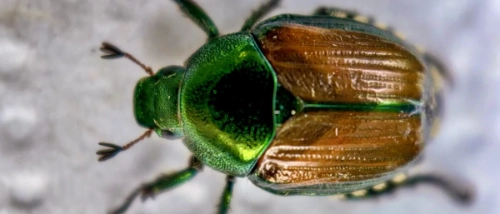
A Japanese beetle, with its metallic green head and copper colored wings

What do Japanese beetles look like?

Adult beetles measure about ½ inch long, with metallic green heads and copper-colored elytra (harder outer layer of their wings) covering the softer hind wings. Small white spots line the edges of their bodies.

Their shiny appearance makes them easy to distinguish from other pests in the garden.

Seeing Japanese beetles?

Call now to book your free inspection.

Signs of a Japanese beetle infestation

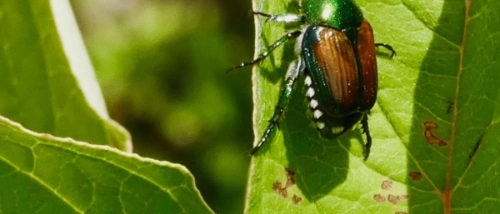
Adult Japanese beetles often gather on roses, linden trees, and other ornamental plants. They skeletonize leaves by eating tissue between the veins, leaving behind a lace-like pattern. 

Underground, Japanese beetle grubs damage turf by feeding on grass roots, creating brown patches that peel up easily. Increased bird activity in lawns can indicate that Japanese beetle larvae feed beneath the soil.

Habitat, diet, life cycle & behaviors

Learn where Japanese beetles live, what they eat, how they develop, and the traits that make them such a persistent pest.

A Japanese beetle, with its metallic green head and copper colored wings

Where do Japanese beetles live?

Japanese beetles are now established in most states, with beetle populations monitored by the U.S. Department of Agriculture and state agencies like WSDA.

They prefer moist soil and sunny environments, which provide both food sources and suitable conditions for egg-laying.

  • Japanese beetles feed on more than 200 species of plants, including fruit trees, field crops, and ornamentals.
  • Above ground, beetle adults attack leaves, flowers, and fruit.
  • Below ground, the larva stage targets turf roots.
  • This combination makes them one of the most destructive pests for both homeowners and farmers.

  • The life cycle begins in late June, when females lay eggs in the soil.
  • After about two weeks, the eggs hatch into grubs.
  • These larvae feed on roots until fall, when they burrow deeper as the soil cools.
  • In spring, they return closer to the surface, continuing to feed until they pupate.
  • The pupa then transforms into adult beetles, restarting the cycle.
  • Seasonal shifts in soil temperatures drive their timing, allowing them to survive cold winters underground.

  • Once they find a suitable food source, beetle adults release pheromone signals that attract more beetles, often resulting in sudden infestations.
  • During feeding, they can strip leaves within hours, creating widespread damage.
  • Because of their group behavior, even small numbers can quickly escalate into major outbreaks.

Are Japanese beetles dangerous?

Japanese beetles are not a direct risk to human health, as they don’t bite or spread disease. However, they can severely harm landscapes, crops, and turf. The economic cost to agriculture is significant, with infestations leading to lost yields and high management expenses. Their ability to thrive without many natural predators in North America makes them a persistent challenge. Our commercial pest control services extend to agricultural operations, so if you’re worried about damage to crops, get in touch.

How to get rid of Japanese beetles

For homeowners, hand removal is sometimes the most immediate option. Shaking beetles from plants into soapy water is effective but time-consuming. Because adult Japanese beetles spend weeks feeding and laying eggs, activity often feels relentless.

Homeowners sometimes try additional methods, such as:

  • Covering plants with mesh during the six to eight-week feeding period to block beetles from access.
  • Laying drop cloths around plants in the early morning, when beetles are most active, to collect and dispose of them in groups.
  • Using Japanese beetle traps, though these may attract more beetles to the area, and often have limited effectiveness.

However, the risk of DIY methods is that, if they don’t work, then infestations can quickly grow. For treatments you can rely on, it’s best to employ the services of the experts at Ehrlich.

For large scale farming endeavors, the challenge is even greater. Removing Japanese beetles is time consuming, difficult and challenging. Remember, so much of the damage these beetles do is underground before they are even seen on the surface. For agricultural businesses with row upon row of crops and plants, trying to do hand-removing and other methods may be difficult to impossible. It can also be very costly to hire more people or try to find ways to remove Japanese beetles on their own, and professional treatments should be considered.
Japanese beetle prevention tips

These steps can reduce activity, but given the mobility of beetle populations, prevention works best when combined with a professional pest control program.

  • Monitor your yard/farm regularly in late June, when beetle activity usually peaks.
  • Reduce thatch and aerate soil to discourage egg-laying.
  • Keep turf healthy, as stressed grass is more vulnerable to Japanese beetle grubs.
  • Cover susceptible plants with mesh during peak feeding times.

Need help with occasional invaders?

Japanese beetles are just one of many seasonal pests that can cause frustration. From beetles to other insect pests, our technicians are trained to identify, monitor, and treat infestations. If you’re worried about Japanese beetles or other occasional invaders, we can help.

Contact Ehrlich today to learn more about our tailored services and how we can help protect your landscape and property with proven Japanese beetle control. Reading up on Japanese beetle facts and resources can help identify the signs of an infestation, but for control and prevention that can help long-term, rely on Ehrlich’s commercial or residential pest control professionals.

Frequently asked questions

No, Japanese beetles do not bite people or animals. They use their mouthparts to chew plants and are only a threat to vegetation. At most, handling them may feel unpleasant, but they are harmless to humans.

Yes, they are considered an invasive species in North America. Without many natural predators, their populations grow quickly and spread to new areas. This is why they cause so much damage to turf and crops.

As the name suggests, the Japanese beetle is native to Japan. It was first found in the United States in 1916 near New Jersey. Since then, it has spread across much of the country and into parts of Canada.

Japanese beetles typically emerge as adults in late June when the soil warms up. This timing can vary slightly depending on the weather and soil conditions. They are most active during the summer months.

Adult beetles usually stay active for six to eight weeks. During this time, they feed, mate, and lay eggs in the soil. Once the season ends, the next generation continues underground as grubs until the following year.

Find your local branch

Enjoy year-round protection from pests with PestFree365+. Ehrlich Pest Control helps protect your home from 39 different pests for the ultimate peace of mind.